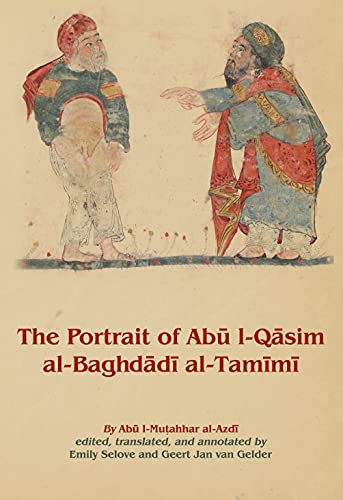
Image de couverture Amazon
Image d'Amazon.com
The Portrait of Abu l-Qāsim Al-Baghdādī al-Tamīmī : Ḥikāyat Abī l-Qāsim al-Baghdādī al-Tamīmī / by Abū l-Muṭahhar al-Azdī (5th/11th c.) ; edited, translated, and annotated by Emily Selove and Geert Jan van Gelder = Ḥikāyaẗ Abī al-Qāsim al-Baġdādī / li-Abī al-Muṭahhar al-Azdī ; ḥaqqaqahā wa-tarǧamahā wa-ʿallaqa ʿalayhā Amilī Sīlūf wa-H̱īrt Yān Fān H̱ildirThe Portrait of Abu l-Qāsim Al-Baghdādī al-Tamīmī : Ḥikāyat Abī l-Qāsim al-Baghdādī al-Tamīmī / by Abū l-Muṭahhar al-Azdī (5th/11th c.) ; edited, translated, and annotated by Emily Selove and Geert Jan van Gelder = حكاية أبي القاسم البغدادي / لأبي المطهر الأزدي ; حققها وترجمها وعلق عليها أملي سيلوف وخيرتيان فان خلدرAuteur principal: الأزدي, محمد بن أحمد أبو المطهر, 10..-11..;Azdī, Muḥammad ibn Aḥmad Abū al-Muṭahhar al-, 10..-11..Co-auteur: Selove, Emily, 19..-....;Gelder, Geert Jan van, 1947-....Titre parallèle : Langue: anglais ; arabe ; de l'oeuvre originale, arabe ; de la page de titre, anglais ; de la page de titre, arabe.Pays: GrandeBretagne (GB).Publication : London : Gibb memorial trust, 2021Description : 1 vol. ([vii]-478 p.) : fac-sim. ; 25 cmISBN: 1-913604-04-7 ; 978-1-913604-04-2.Dewey: 892.7334, 23Résumé: Ḥikāyat Abī l-Qāsim al-Baghdādī (The Portrait of Abu l-Qāsim Al-Baghdādī al-Tamīmī) is an 11th century Arabic work by Abū l-Muṭahhar Muḥammad ibn Aḥmad al-Azdī which tells the story of a Baghdadi party-crasher crashing a party in Isfahan. It is introduced by its author as a microcosm of Baghdad. This work, written in prose but containing numerous poems, is widely hailed among scholars as a narrative unique in the history of Arabic literature, but The Portrait also reflects a much larger tradition of banquet texts, from "Trimalchio's Dinner Party" and Plato's Symposium to the works of Rabelais. It also paints a portrait of a party-crasher who is at once a holy man and a rogue, a figure familiar among scholars of the ancient Cynic tradition or other portrayals of wise fools, tricksters, and saints from literatures around the Mediterranean and beyond. While some early scholars of The Portrait dismissed it as disgusting and obscene, this work, with its wealth of material-cultural, philosophical, spiritual, and literary treasures, is much more than just a 'dirty book'. Following an introduction, which offers new insights into the relationship of the work to both its Greek predecessors and to its European descendants, the volume presents a new, improved edition of the Arabic text, together with a richly annotated translation, that aims at being both scholarly and readable, reflecting the often racy style of the Arabic. This makes it not only useful to specialists and students of medieval Arabic literature, but also accessible to a much wider general readership of those interested in comparative literature or 'world literature'. There are extensive indexes of names, places, subjects, and rhymes..Bibliographie: Bibliogr. p. [460]-478. Notes bibliogr. Index.Sujet - Nom commun: Moeurs et coutumes Bagdad (Irak) Sujet - Nom géographique: Baghdad (Iraq) -- Social life and customs -- Fiction Sujet - Forme, genre, caractéristique physique: Littérature arabe, 750-1258
Type de document : Monographie Ce document apparaît dans la/les liste(s) : Erbil-Acquisitions 2025-trimestre 1
Exemplaires
Site actuel Collection Cote Statut Code à barres
Bibliothèque Beyrouth Magasin Achat Erb-8°-1122 Disponible 4001626

Texte arabe vocalisé et traduction anglaise en regard.

Bibliogr. p. [460]-478. Notes bibliogr. Index

Ḥikāyat Abī l-Qāsim al-Baghdādī (The Portrait of Abu l-Qāsim Al-Baghdādī al-Tamīmī) is an 11th century Arabic work by Abū l-Muṭahhar Muḥammad ibn Aḥmad al-Azdī which tells the story of a Baghdadi party-crasher crashing a party in Isfahan. It is introduced by its author as a microcosm of Baghdad. This work, written in prose but containing numerous poems, is widely hailed among scholars as a narrative unique in the history of Arabic literature, but The Portrait also reflects a much larger tradition of banquet texts, from "Trimalchio's Dinner Party" and Plato's Symposium to the works of Rabelais. It also paints a portrait of a party-crasher who is at once a holy man and a rogue, a figure familiar among scholars of the ancient Cynic tradition or other portrayals of wise fools, tricksters, and saints from literatures around the Mediterranean and beyond. While some early scholars of The Portrait dismissed it as disgusting and obscene, this work, with its wealth of material-cultural, philosophical, spiritual, and literary treasures, is much more than just a 'dirty book'. Following an introduction, which offers new insights into the relationship of the work to both its Greek predecessors and to its European descendants, the volume presents a new, improved edition of the Arabic text, together with a richly annotated translation, that aims at being both scholarly and readable, reflecting the often racy style of the Arabic. This makes it not only useful to specialists and students of medieval Arabic literature, but also accessible to a much wider general readership of those interested in comparative literature or 'world literature'. There are extensive indexes of names, places, subjects, and rhymes. 4e de couverture

Partager