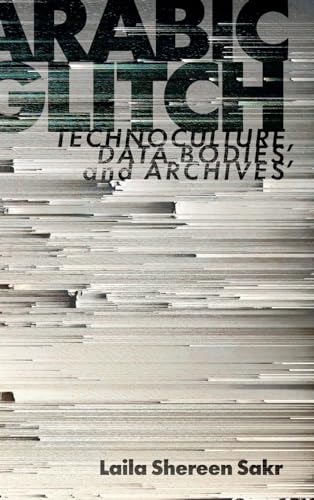
Image de couverture Amazon
Image d'Amazon.com
Arabic glitch : technoculture, data bodies, and archives / Laila Shereen SakrAuteur principal: Sakr, Laila ShereenLangue: anglais ; du résumé, anglais ; de la page de titre, anglais ; du titre propre, anglais.Pays: EtatsUnis (US).Publication : Stanford, California : Stanford University Press, [2023]Description : 1 vol. (xiv- 180 p.) : ill. ; 24 cmISBN: 978-1-5036-3099-4 ; 1-5036-3099-4 ; 978-1-5036-3588-3 ; 1-5036-3588-0 ; .Dewey: 302.302850917/4927, 23/eng/20221101Note de contenu: Introduction : a posthuman techno-feminist praxis Glitch in the age of technoculture Arab data bodies Digital activism Aggregation as archive Art practice Conclusion : fix your own democracy Résumé: "Arabic Glitch explores an alternative origin story of twenty-first century technological innovation in digital politics--one centered on the Middle East and the 2011 Arab uprisings. Developed from an archive of social media data collected over the decades following the 2003 U.S. invasion of Iraq, this book interrogates how the logic of programming technology influences and shapes social movements. Engaging revolutionary politics, Arab media, and digital practice in form, method, and content, Laila Shereen Sakr formulates a media theory that advances the concept of the glitch as a disruptive media affordance. She employs data analytics to analyze tweets, posts, and blogs to describe the political culture of social media, and performs the results under the guise of the Arabic-speaking cyborg VJ Um Amel. Playing with multiple voices that span across the virtual and the real, Sakr argues that there is no longer a divide between the virtual and embodied: both bodies and data are physically, socially, and energetically actual. Are we cyborgs or citizens--or both? This book teaches us how a region under transformation became a vanguard for new thinking about digital systems: the records they keep, the lives they impact, and how to create change from within".Bibliographie: Bibliogr. p. [153]. Index.Sujet - Nom commun: Online social networks -- Political aspects -- Arab countries | Social media -- Political aspects -- Arab countries | Communication in politics -- Arab countries | Political participation -- Arab countries | Social movements -- Arab countries | Arab Spring, 2010- | Printemps arabe, 2010-2011 | Internet -- Aspect politique Pays arabes | Internet -- Société Pays arabes | Réseaux sociaux (Internet) -- Aspect politique Pays arabes | Réseaux sociaux (Internet) -- Société Pays arabes | Printemps arabe (2010-....) Sujet - Nom géographique: Arab countries -- Politics and government -- 21st century | États arabes -- Politique et gouvernement -- 21e siècle | Arab countries
Type de document : Monographie Ce document apparaît dans la/les liste(s) : BEYROUTH-Acquisitions 2025-trimestre 3
Exemplaires
Site actuel Collection Cote Statut Code à barres
Bibliothèque Beyrouth Présentoirs-Libre accès Achat BEY-8°-12032 Disponible 1040390

Bibliogr. p. [153]. Index

Introduction : a posthuman techno-feminist praxis Glitch in the age of technoculture Arab data bodies Digital activism Aggregation as archive Art practice Conclusion : fix your own democracy

"Arabic Glitch explores an alternative origin story of twenty-first century technological innovation in digital politics--one centered on the Middle East and the 2011 Arab uprisings. Developed from an archive of social media data collected over the decades following the 2003 U.S. invasion of Iraq, this book interrogates how the logic of programming technology influences and shapes social movements. Engaging revolutionary politics, Arab media, and digital practice in form, method, and content, Laila Shereen Sakr formulates a media theory that advances the concept of the glitch as a disruptive media affordance. She employs data analytics to analyze tweets, posts, and blogs to describe the political culture of social media, and performs the results under the guise of the Arabic-speaking cyborg VJ Um Amel. Playing with multiple voices that span across the virtual and the real, Sakr argues that there is no longer a divide between the virtual and embodied: both bodies and data are physically, socially, and energetically actual. Are we cyborgs or citizens--or both? This book teaches us how a region under transformation became a vanguard for new thinking about digital systems: the records they keep, the lives they impact, and how to create change from within"

Partager