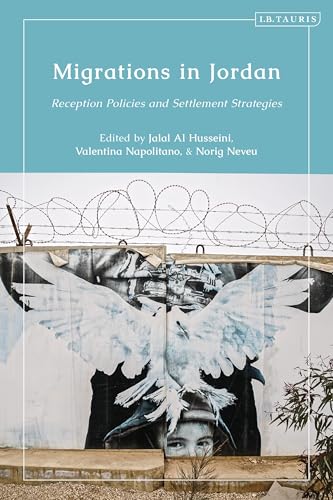
Image de couverture Amazon
Image d'Amazon.com
Migrations in Jordan : reception policies and settlement strategies / edited by Jalal Al Husseini, Norig Neveu, Valentina NapolitanoAuteur principal: Husseini, Jalal al-Co-auteur: Neveu, Norig, 19..-....;Napolitano, ValentinaLangue: anglais.Pays: GrandeBretagne (GB).Publication : London, New York : I.B. Tauris, 2024Description : 1 vol. (285 pages) ; 24 cmISBN: 978-0-7556-0684-9.Dewey: 305.9, 23Résumé: "Jordan currently hosts the second largest percentage of registered refugees in the world: three million out of its eleven million inhabitants. Its experience in hosting migrants and refugees precedes its independence in 1946, with the arrival of Circassians, Chechens, and Armenians from the late 19th century. Jordan thus constitutes a unique observatory for reception policies and long-term settlement of different migrant groups. Based on original empirical and archival material, this volume focuses on migrations caused by conflicts, wars, and crises underscoring their articulation with longstanding human mobility. It sheds light on the cumulative and processual dimensions of Jordan's reception policies and migrants' settlement strategies. It identifies the multiple actors involved in the management of migrants and, conversely, the latter's contribution to the Jordanian social, economic, political, and urban fabric. The first part of the volume examines the policies adopted by the Jordanian authorities and international organizations to regulate access to basic services and to the labour market, and explores the economic and political factors underlying them. The second part analyzes the effects of Jordan's policies on the territorial distribution and settlement of migrants. How have these policies, combined with the adaptation strategies of migrants contributed to shaping new urban spaces? The third part focuses on capacity of the migrants to activate, establish, (re)build, and intersect different kinds of solidarity networks within the context of protracted displacement."..Bibliographie: Notes bibliogr. en fin de chapitre. Index..Sujet - Nom commun: Refugees -- Jordan | Forced migration -- Middle East | Transferts de population Moyen-Orient | Refugees -- Government policy -- Jordan | Refugees -- Jordan -- Social conditions | Réfugiés syriens Jordanie Sujet - Nom géographique: Jordan -- Emigration and immigration | Syrie -- History -- Civil War, 2011- -- Refugees | Jordanie Émigration et immigration | Syrie, 2011-.... (Guerre civile), Campagnes et batailles
Type de document : Monographie Ce document apparaît dans la/les liste(s) : AMMAN-Acquisitions 2024-trimestre 4
Exemplaires
Site actuel Collection Cote Statut Code à barres
Bibliothèque Amman Magasin Don Amm-8°-3002 Disponible 2004737

Notes bibliogr. en fin de chapitre. Index.

"Jordan currently hosts the second largest percentage of registered refugees in the world: three million out of its eleven million inhabitants. Its experience in hosting migrants and refugees precedes its independence in 1946, with the arrival of Circassians, Chechens, and Armenians from the late 19th century. Jordan thus constitutes a unique observatory for reception policies and long-term settlement of different migrant groups. Based on original empirical and archival material, this volume focuses on migrations caused by conflicts, wars, and crises underscoring their articulation with longstanding human mobility. It sheds light on the cumulative and processual dimensions of Jordan's reception policies and migrants' settlement strategies. It identifies the multiple actors involved in the management of migrants and, conversely, the latter's contribution to the Jordanian social, economic, political, and urban fabric. The first part of the volume examines the policies adopted by the Jordanian authorities and international organizations to regulate access to basic services and to the labour market, and explores the economic and political factors underlying them. The second part analyzes the effects of Jordan's policies on the territorial distribution and settlement of migrants. How have these policies, combined with the adaptation strategies of migrants contributed to shaping new urban spaces? The third part focuses on capacity of the migrants to activate, establish, (re)build, and intersect different kinds of solidarity networks within the context of protracted displacement.". éditeur

Partager