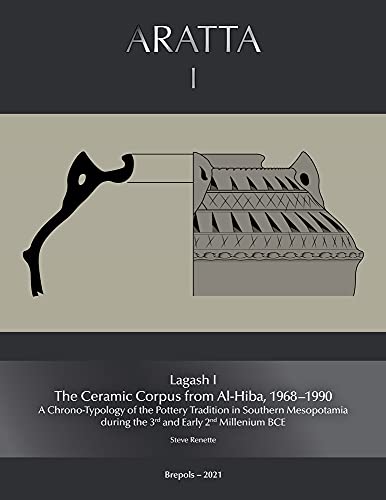
Image de couverture Amazon
Image d'Amazon.com
Lagash I : the ceramic corpus from al-Hiba, 1968-1990 : a chrono-typology of the pottery tradition in southern Mesopotamia during the third and early second millenium BCE / Steve RenetteAuteur principal: Renette, SteveLangue: anglais.Pays: Belgique (BE).Publication : Turnhout : Brepols, DL 2021Description : 1 volume (XXIV-447 pages) : illustrations en noir et en couleurs, graphiques, cartes, fac-similés, couverture illustrée ; 28 cmCollection : Aratta, studies in archaeology & history, from Mesopotamia to the Indus Valley, general editors Marc Lebeau,... Holly Pittman,..., 2021, Turnhout, Brepols, 1ISBN: 978-2-503-59020-2 ; 2-503-59020-9.Dewey: 935.01, 23Résumé: Six seasons of excavations (1968-90) at the southern Mesopotamian site of al-Hiba, the ancient city of Lagash, retrieved one of the largest datasets of pottery spanning the entire third and early second millennium BCE. Between 1968 and 1990, Donald P. Hansen and Vaughn E. Crawford directed six seasons of excavations at al-Hiba, the ancient Sumerian city-state Lagash. Overseen by Edward L. Ochsenschlager, the team documented one of the largest ceramic datasets from a southern Mesopotamian site spanning the entire third and the early second millennium BCE. With the availability of digital tools and relational database technology, the Al-Hiba Publication Project, led by Holly Pittman at the Penn Museum, can now analyze these results in preparation of final publication. As a case-study in the difficulties of working with legacy data, the publication project also assesses how the original recording methodology structures and limits the interpretation of these datasets. This first volume of the Lagash publications presents the ceramic corpus organized in a chrono-typology that traces the development of the pottery tradition through the Early Dynastic, Akkadian, Ur III, and Isin-Larsa periods. Often confirming well-established trends in general Mesopotamian ceramic development, this dataset from the south-eastern part of the Mesopotamian alluvium also introduces an underappreciated degree of regional variation..Bibliographie: Bibliographie pages [441]-447. Notes bibliographiques.Sujet - Nom commun: Fouilles archéologiques Lagash (ville ancienne) | Céramique Lagash (ville ancienne) | Excavations (Archaeology) -- Iraq -- Lagash (Extinct city) | Pottery -- Iraq -- Lagash (Extinct city) Sujet - Nom géographique: Mésopotamie, 2900-2350 av. J.-C. (Dynasties archaïques) | Mésopotamie 2e millénaire av. J.-C | Lagash (Extinct city)
Autre édition : Lagash I / Steve Renette Type de document : Monographie Ce document apparaît dans la/les liste(s) : ERBIL-Acquisitions-2023-Trimestres 1 à 3 | Erbil-Acquisitions-2023
Exemplaires
Site actuel Collection Cote Statut Code à barres
Bibliothèque Erbil Libre accès Achat Erb-4°-0313/1 Disponible 4001662

Bibliographie pages [441]-447. Notes bibliographiques

Six seasons of excavations (1968-90) at the southern Mesopotamian site of al-Hiba, the ancient city of Lagash, retrieved one of the largest datasets of pottery spanning the entire third and early second millennium BCE. Between 1968 and 1990, Donald P. Hansen and Vaughn E. Crawford directed six seasons of excavations at al-Hiba, the ancient Sumerian city-state Lagash. Overseen by Edward L. Ochsenschlager, the team documented one of the largest ceramic datasets from a southern Mesopotamian site spanning the entire third and the early second millennium BCE. With the availability of digital tools and relational database technology, the Al-Hiba Publication Project, led by Holly Pittman at the Penn Museum, can now analyze these results in preparation of final publication. As a case-study in the difficulties of working with legacy data, the publication project also assesses how the original recording methodology structures and limits the interpretation of these datasets. This first volume of the Lagash publications presents the ceramic corpus organized in a chrono-typology that traces the development of the pottery tradition through the Early Dynastic, Akkadian, Ur III, and Isin-Larsa periods. Often confirming well-established trends in general Mesopotamian ceramic development, this dataset from the south-eastern part of the Mesopotamian alluvium also introduces an underappreciated degree of regional variation. site web de l'éditeur

Partager