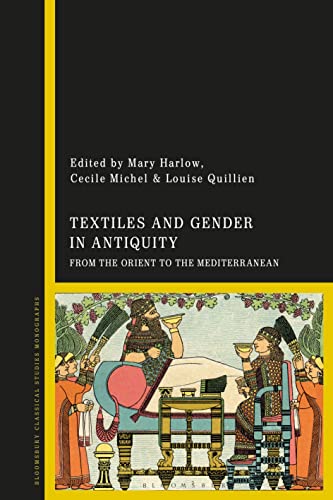
Image de couverture Amazon
Image d'Amazon.com
Textiles and gender in antiquity : from the Orient to the Mediterranean / edited by Mary Harlow, Cécile Michel and Louise QuillienAuteur principal: Harlow, Mary, 1956-....Co-auteur: Michel, Cécile, 1962-....;Quillien, Louise, 1986-....Langue: anglais.Pays: GrandeBretagne (GB), EtatsUnis (US).Publication : London, New York, NY : Oxford [ect] : Bloomsbury Academic, 2020Description : 1 vol. (XIX-308 p.-[16] p. de pl.) : ill., couv. ill. en coul., fig., photos ; 24 cmCollection : Bloomsbury Classical Studies Monographs, Classics & Archaeology, London [etc.], Bloomsbury Academic, 201XISBN: 978-1-3501-4149-0 ; 1-3501-4149-6 ; 978-1-350-18973-7 ; 1-350-18973-1.Dewey: 391.009, 23Résumé: "This volume looks at how the issues of textiles and gender intertwine across three millennia in antiquity and examines continuities and differences across time and space - with surprising resonances for the modern world. The interplay of gender, identity, textile production and use is notable on many levels, from the question of who was involved in the transformation of raw materials into fabric at one end, to the wearing of garments and the construction of identity at the other. Textile production has often been considered to follow a linear trajectory from a domestic (female) activity to a more 'commercial' or 'industrial' (male-centred) mode of production. In reality, many modes of production co-existed and the making of textiles is not so easily grafted onto the labour of one sex or the other. Similarly, textiles once transformed into garments are often of 'unisex' shape but worn to express the gender of the wearer. As shown by the detailed textual source material and the rich illustrations in this volume, dress and gender are intimately linked in the visual and written records of antiquity. The contributors show how it is common practice in both art and literature not only to use particular garments to characterize one sex or the other, but also to undermine characterizations by suggesting that they display features usually associated with the opposite gender".Bibliographie: Bibliogr. en fin de contributions. Notes bibliogr. Index.Sujet - Nom commun: Vêtements -- Méditerranée (région) Antiquité | Vêtements -- Orient Antiquité | Textiles et tissus pour l'habillement -- Méditerranée (région) Antiquité | Textiles et tissus pour l'habillement -- Orient Antiquité | Rôle selon le sexe -- Méditerranée (région) Antiquité | Rôle selon le sexe -- Orient Antiquité | Clothing and dress -- History -- To 1500 | Women's clothing -- History -- To 1500 | Textile fabrics -- History -- To 1500 | Sex role -- History -- To 1500
Type de document : Monographie Ce document apparaît dans la/les liste(s) : BEYROUTH-Acquisitions-2023-trimestre 1 | BEYROUTH-Acquisitions-2023
Exemplaires
Site actuel Collection Cote Statut Code à barres
Bibliothèque Beyrouth Magasin Achat BEY-8°-11569 Disponible 1037661

Autre tirage : 2021, 2022 (éd. brochée)

Bibliogr. en fin de contributions. Notes bibliogr. Index

"This volume looks at how the issues of textiles and gender intertwine across three millennia in antiquity and examines continuities and differences across time and space - with surprising resonances for the modern world. The interplay of gender, identity, textile production and use is notable on many levels, from the question of who was involved in the transformation of raw materials into fabric at one end, to the wearing of garments and the construction of identity at the other. Textile production has often been considered to follow a linear trajectory from a domestic (female) activity to a more 'commercial' or 'industrial' (male-centred) mode of production. In reality, many modes of production co-existed and the making of textiles is not so easily grafted onto the labour of one sex or the other. Similarly, textiles once transformed into garments are often of 'unisex' shape but worn to express the gender of the wearer. As shown by the detailed textual source material and the rich illustrations in this volume, dress and gender are intimately linked in the visual and written records of antiquity. The contributors show how it is common practice in both art and literature not only to use particular garments to characterize one sex or the other, but also to undermine characterizations by suggesting that they display features usually associated with the opposite gender" 4e de couverture

Partager